
Stop Collecting Properties. Start Building a Portfolio.
The Accidental Landlord Trap
It starts innocently enough. You buy your first rental property, maybe a duplex or a single-family home in a decent neighborhood. It goes well, so you buy another. Then, a few years later, you leverage some equity and pick up two more. Suddenly, you look up and you’re juggling four, five, maybe six properties.
You have a collection of assets. But do you have a cohesive strategy? For many investors, the honest answer is no.
You’ve fallen into the Accidental Landlord Trap. Your days are spent dealing with tenants, toilets, and trash—a never-ending cycle of reactive problem-solving. You’re a firefighter, constantly rushing to put out small blazes across your little empire. It’s exhausting, and it’s not scalable.
Shifting Your Mindset from Property to Portfolio
True wealth in real estate isn’t built by simply accumulating doors. It’s built by making a critical mental shift: from landlord to CEO. This is the heart of real estate portfolio management.
It’s the difference between being a firefighter and being an architect. The architect doesn’t lay every brick; they design the entire structure for stability, function, and long-term growth. They think about how the east wing complements the west wing, how the foundation supports the upper floors, and how the entire building will weather the storms of the future.
This guide is your blueprint. It will show you how to stop managing properties and start managing a portfolio—to make that crucial leap from accidental landlord to strategic real estate CEO.
What Exactly Is Real Estate Portfolio Management? (And Why It Isn’t Just Property Management)

The 30,000-Foot View: Your Portfolio as a Single Business
Think about a savvy stock market investor for a moment. They don’t obsess over Apple’s stock price every single second of the day. Instead, they look at their entire portfolio. They analyze its overall performance, its balance between aggressive tech stocks and stable index funds, and its alignment with their long-term financial goals.
That is precisely what real estate portfolio management brings to your properties. It’s the practice of applying high-level, strategic thinking to your entire collection of assets, treating them as a single, unified business entity.
Portfolio Manager vs. Property Manager: A Crucial Distinction
Many investors confuse these two roles, and it’s a costly mistake. They are fundamentally different, and you need to understand why. Let’s break down the seperate roles:
- The Property Manager: This is your tactical, on-the-ground expert. Their world revolves around a single asset. They handle the day-to-day operations: finding and screening tenants, collecting rent, coordinating repairs, and handling late-night emergency calls about a burst pipe. They work in the business.
- The Portfolio Manager: This is the strategic, big-picture thinker. (That’s you!) Their world revolves around the entire collection of assets. They analyze financial performance across all properties, identify markets for expansion, structure financing for new acquisitions, and make the tough call on when to sell an underperforming property. They work on the business.
A great property manager keeps a single property running smoothly. A great portfolio manager ensures the entire collection of properties is steering you toward your ultimate financial destination.
The 4 Pillars of a High-Performing Real Estate Portfolio

Ready to put on your CEO hat? A robust and profitable portfolio isn’t built on luck. It’s built on four distinct pillars that provide structure, direction, and resilience.
👉 À lire aussi : Beyond the Keys: Unlocking Portfolio Value with Real…
Pillar 1: Defining Your Grand Strategy (Your Investment Thesis)
Stop buying properties until you do this. Before you even look at another listing, you need a written investment thesis. This is your north star, the guiding document for every single decision you make.
Ask yourself the hard questions and write down the answers:
- What is my primary goal? Is it maximum monthly cash flow to achieve early retirement by 45? Or is it long-term appreciation for generational wealth?
- What is my risk tolerance? Am I hungry for value-add projects that require significant renovation, or do I prefer stable, turnkey rentals that produce income from day one?
- What type of assets will I focus on? Single-family homes, small multifamily (2-4 units), short-term vacation rentals?
- In which specific markets or submarkets will I operate?
Your thesis isn’t just a fluffy mission statement. It’s a set of rules. If a “great deal” on a commercial strip mall comes across your desk but your thesis is focused on Class B multifamily, you immediately say no. It keeps you disciplined and focused.
Pillar 2: Strategic Acquisition and Disposition
This pillar is about more than just chanting “location, location, location.” It’s about buying the right asset, at the right time, for the right price—and, just as importantly, knowing when to sell.
📖 Lire aussi : Residential Property Management: The Landlord’s…
A portfolio CEO isn’t emotionally attached to their properties. They are attached to performance. They aren’t afraid to prune the portfolio by selling a C-grade property that’s draining time and resources, even if it was their “first.” Why? Because they know they can take that capital and redeploy it into acquiring two B+ properties that better align with their investment thesis and accelerate their growth.
Pillar 3: Obsessive Financial Tracking and Analysis
If you’re still thinking in terms of “rent minus mortgage,” you’re operating in the dark. To truly manage a portfolio, you must speak the language of financial metrics. You need to track Key Performance Indicators (KPIs) for each property and for the portfolio as a whole.
Here are the non-negotiables:
- Net Operating Income (NOI): This is your property’s income after all operating expenses but before mortgage payments and taxes. It tells you how profitable the asset itself is, independent of financing.
- Capitalization Rate (Cap Rate): Calculated as NOI / Property Value. This metric allows you to compare the potential return of different properties on an apples-to-apples basis.
- Cash-on-Cash Return (CoC): This is the golden metric. It’s your annual pre-tax cash flow divided by the total cash you invested. It tells you exactly what return you’re getting on the actual money you have in the deal. We’re aiming for a portfolio-wide CoC return of over 10%.
Tracking these numbers transforms you from a guesser into a data-driven decision-maker.
Pillar 4: Intelligent Risk Mitigation and Diversification
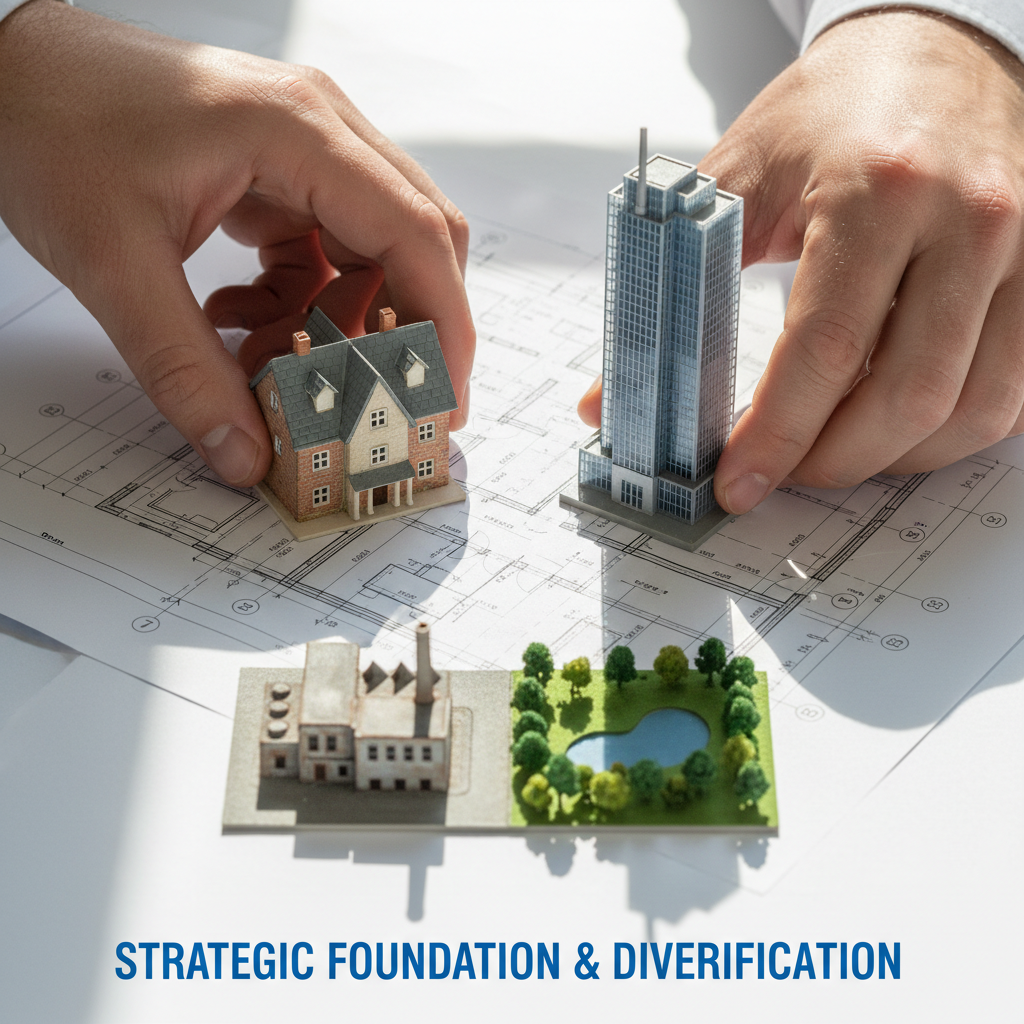
Don’t put all your eggs in one basket. It’s a cliché for a reason. A single-employer town can be devastated by a factory closure. A single asset class can fall out of favor. Effective real estate portfolio management is about building a resilient business that can withstand market shocks.
📖 Dans le même thème : Property Management: The Landlord’s Ultimate Guide to…
Diversification can take many forms:
- Geographic Diversification: Owning properties in different cities or states. You could balance a stable, cash-flowing property in the Midwest with a high-growth asset in the Sun Belt.
- Asset Class Diversification: Mixing single-family homes with small multifamily units or even a short-term vacation rental.
- International Diversification: For sophisticated investors, this could mean balancing a domestic portfolio with a high-yield vacation rental in an international market like Phuket. This definately spreads your risk across different economies and tourism trends.
The Modern Portfolio Manager’s Toolkit
Leveraging Technology: From Spreadsheets to Software
You can’t manage what you don’t measure. In 2024, managing a growing portfolio with a shoebox full of receipts is just not an option.
At a minimum, you need a detailed spreadsheet (like Google Sheets or Excel) to track income, expenses, and your key metrics for each property. But as you scale, dedicated software becomes a game-changer.
Tools like Stessa or Buildium are designed for this. They link directly to your bank accounts, automate expense tracking, and provide a clean dashboard of your portfolio’s financial health. The goal of technology is simple: to turn messy data into clear, actionable insights with just a few clicks.
📖 Vous aimerez aussi : Success Property Management: Proven Strategies to…
Building Your ‘A-Team’: The Indispensible Human Element
No software can ever replace a network of trusted professionals. As the portfolio CEO, your job is to assemble and manage your ‘A-Team.’ This is a non-negotiable part of scaling successfully.
Your team should include:
- A Real Estate Agent Who Is an Investor: You need an agent who understands cap rates and cash flow, not just granite countertops.
- A Real Estate Accountant: A CPA who specializes in real estate can save you tens of thousands of dollars through strategies like cost segregation and maximizing depreciation.
- A Rock-Solid Lawyer: For everything from entity structuring (LLCs) to reviewing leases and handling evictions.
- Reliable Property Managers: They are your boots on the ground. A great PM is worth their weight in gold.
For example, if you decide to diversify and invest overseas in a place like Phuket, having a trustworthy local property management team is not a luxury, it’s an absolute necessity for sucess. This human element is truly indispensible.
3 Costly Mistakes to Avoid at All Costs
Shifting to a portfolio mindset also means learning to sidestep the common traps that keep landlords stuck. Here are three of the most dangerous.
Mistake #1: The Disease of ‘Emotional Attachment’
We’ve all felt it. You get attached to your very first rental property. You love the tenants in the duplex on Elm Street. But a portfolio CEO cannot afford to make decisions based on sentimentality. The numbers don’t have feelings, and neither should your analysis.
If a property consistently underperforms, no longer fits your investment thesis, or is tying up capital that could be better used elsewhere, it’s time to sell. It’s a business asset, not a family pet.
📖 Article connexe : The True Cost of Property Management: A Complete 2024…
Mistake #2: Tolerating Underperforming ‘Zombie’ Properties
This is the silent portfolio killer. A “zombie” property isn’t a total disaster. It’s not losing a ton of money, but it isn’t really making much, either. It just shuffles along, breaking even or generating a tiny amount of cash flow.
The danger is the massive opportunity cost. The equity trapped in that zombie property—say, $100,000—could be used as a down payment on a $400,000 asset that generates a 12% cash-on-cash return. By holding onto the zombie, you’re forfeiting thousands in potential income every year. Be ruthless in identifying and eliminating these from your portfolio.
Mistake #3: The ‘Set It and Forget It’ Mindset
The real estate market of 2024 is vastly different from 2019. Interest rates have changed. Rental demand has shifted. Your own financial goals have likely evolved.
A high-performing portfolio requires active management and periodic review. Your investment thesis is not meant to be carved in stone; it’s a living document. At least once a year, you must conduct a formal strategic review of your entire portfolio. What worked last year might be a liability next year. Adapt or get left behind.
Conclusion: Make Your First CEO Decision Today
The journey from landlord to portfolio CEO is the single most powerful shift you can make to build scalable, sustainable wealth in real estate. It’s the difference between owning a job and owning a business.
This is about proactive strategy, not reactive problem-solving. It’s about seeing the entire forest, not just the individual trees. It is the core discipline of professional real estate portfolio management.
So, here’s your homework. Your first official act as CEO.
Block out two uninterrupted hours on your calendar this week. Pull up a spreadsheet. Lay out every single one of your properties and their core financials: income, expenses, debt, and equity. Calculate the Net Operating Income, Cash-on-Cash Return, and Cap Rate for each. This is your first board meeting. You’re in charge.
Look at the data. What does it tell you? What’s your next move?
FAQ
What exactly is real estate portfolio management?
Real estate portfolio management is the strategic process of overseeing a collection of property investments to achieve specific financial goals. It goes beyond simple property management by focusing on the big picture, including asset acquisition, risk analysis, financing, and disposition strategies to maximize overall returns.
How is portfolio management different from property management?
Property management focuses on the day-to-day operations of a single property, such as collecting rent, maintenance, and tenant relations. Portfolio management is a higher-level discipline that looks at the entire collection of assets, making strategic decisions about which properties to buy, hold, or sell to optimize the portfolio’s performance.
What are the first steps to building a real estate portfolio?
Start by defining your investment goals, such as cash flow, appreciation, or a mix of both, and determine your risk tolerance. Next, secure financing and begin researching markets and property types that align with your strategy. Your first property is the foundation, so perform thorough due diligence before purchasing.
How can I diversify my real estate portfolio to reduce risk?
Diversification involves spreading your investments across different property types (e.g., residential, commercial, industrial) and geographic locations. This strategy helps protect your portfolio from a downturn in a single market or asset class, ensuring that the poor performance of one investment doesn’t significantly impact your overall financial health.
What key metrics should I track for my portfolio?
It’s crucial to track metrics for both individual properties and the portfolio as a whole. Key indicators include Net Operating Income (NOI), Cash-on-Cash Return, and Capitalization (Cap) Rate. Regularly reviewing these numbers helps you identify underperforming assets and make informed decisions.