
It’s 2:17 AM on a Tuesday. Your phone buzzes, a harsh vibration on the nightstand that jolts you from a deep sleep. It’s your tenant. The upstairs toilet is not just clogged; it’s actively overflowing, and water is starting to seep through the ceiling into the living room below. Your dream of passive income suddenly feels very, very active.
This is the moment every DIY landlord dreads. It’s the moment you realize your ‘free’ time isn’t free at all. It’s paid for with stress, emergency calls, and endless weekends spent chasing rent checks or interviewing plumbers.
Hiring a property manager seems like the obvious answer, a magic bullet for reclaiming your sanity. But then they hand you the management agreement, and your eyes glaze over. It’s a confusing maze of percentages, flat fees, and a dozen other line items that make you question everything. Are they helping you or just helping themselves to your profits?
This guide isn’t just another list of fees. Think of it as your roadmap. We’re going to decode the jargon, break down the numbers, and help you understand exactly what you’re paying for. By the end, you’ll be able to calculate whether a property manager is a brilliant investment for your rental or an unecessary expense.
The Core Fee Structures: Flat vs. Percentage
Before we get lost in the weeds of add-on charges, let’s start with the foundation. Nearly every property management company structures its main fee in one of two ways: as a percentage of rent or as a flat monthly fee. Think of it like choosing between a commission-based salesperson and a salaried employee; both have their own set of incentives and potential drawbacks.

The Percentage-Based Fee (The Industry Standard)
This is, by far, the most common model you’ll encounter. The manager charges a percentage, typically between 8% and 12%, of the monthly rent collected. So, on a property that rents for $2,000 a month, a 10% fee means you’re paying the manager $200 each month.
The beauty of this model is the alignment of interests. If the property is vacant and you’re not collecting rent, they aren’t getting paid either. This simple fact incentivizes them to find a quality tenant quickly and to keep them happy. They are motivated to get you the highest possible market rent because their income rises with yours.
- Pros: Directly ties the manager’s pay to your property’s performance. No rent means no fee. Motivates them to minimize vacancies and maximize rental rates.
- Cons: For high-rent properties, this can become quite expensive. A 10% fee on a $4,500/month luxury rental is $450, which might feel steep compared to the actual work involved each month.
The Flat-Fee Model (A Growing Alternative)
On the flip side, some companies offer a predictable, fixed monthly fee. This might range from $100 to $250 per month, regardless of the rental amount. For a landlord with a high-end property, this can be a massive win.
That same $4,500/month rental might only cost you a $150 flat fee, saving you $300 every single month. The predictability is fantastic for budgeting. You know exactly what your management cost will be, month in and month out.
However, the potential downside is a question of motivation. If the manager gets paid the same whether your property rents for $1,800 or $2,200, is their incentive to push for that top-of-market rate as strong? Some argue it isn’t, while others believe a good company’s reputation depends on getting great results regardless of their fee structure.
👉 À lire aussi : From Landlord to CEO: Mastering Real Estate Portfolio…
- Pros: Predictable costs for easy budgeting. Often more economical for properties with higher-than-average rental rates.
- Cons: The manager’s pay isn’t directly tied to the rental amount, which could potentially reduce their incentive to negotiate for the highest possible rent.
Beyond the Monthly Fee: The ‘A La Carte’ Menu of Charges
This is where the real confusion begins. The monthly management fee is just the appetizer. The main course is a long list of additional charges for specific services. A lack of transparency here is a major red flag, so you need to know what to look for. These are the most common fees you’ll see.
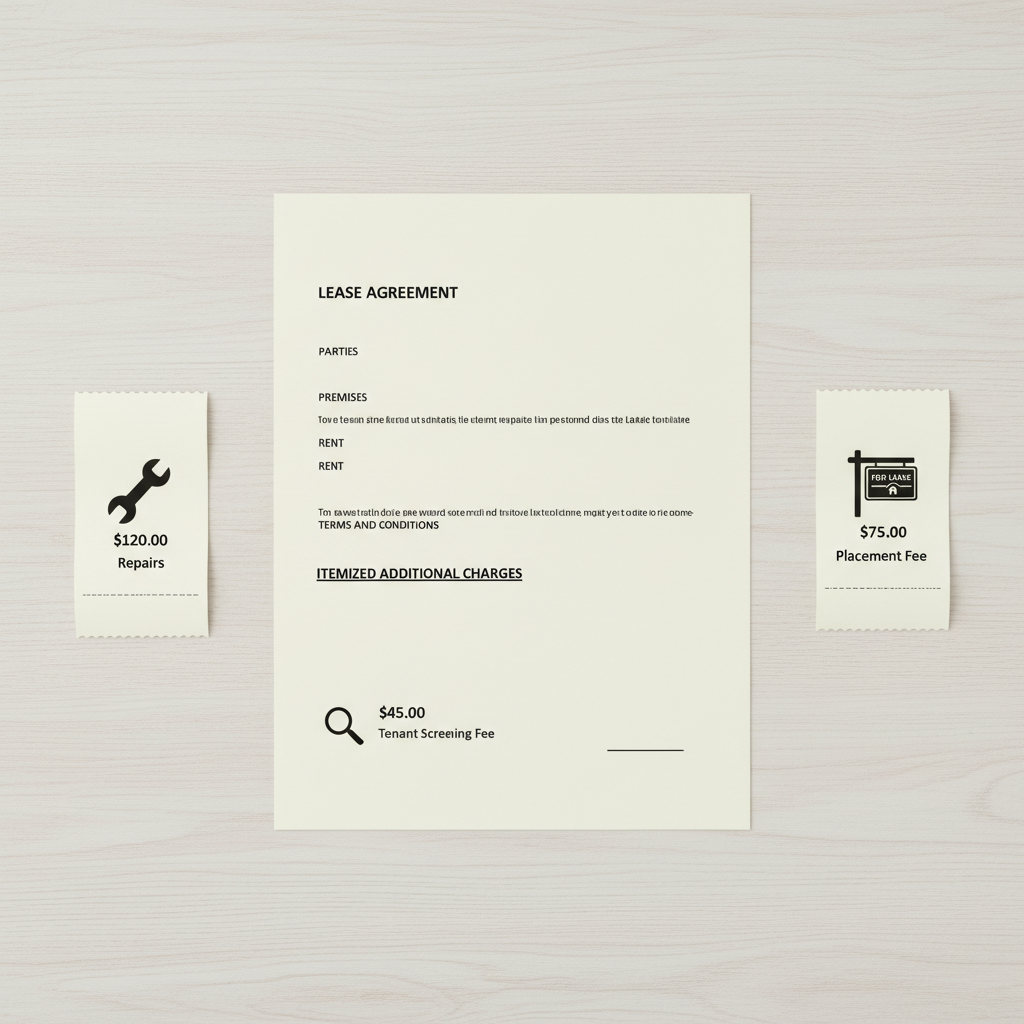
The Leasing Fee (or Tenant Placement Fee)
This is a one-time charge for the significant work involved in placing a new tenant. It typically costs between 50% to 100% of the first month’s rent. Before you balk at the price, consider what it covers:
- Professional photography and marketing your property across multiple platforms.
- Responding to dozens (or hundreds) of inquiries.
- Conducting multiple showings.
- Processing applications and running comprehensive background, credit, and eviction checks.
- Drafting and executing a legally compliant lease agreement.
- Conducting a move-in inspection and handling key exchange.
This is arguably one of the most valuable services offered. A bad tenant can cost you thousands in damages and lost rent; a great one is worth their weight in gold. Paying a professional to handle this critical preperation and screening process is often money well spent.
The Lease Renewal Fee
What happens when your great tenant wants to stay for another year? Many managers charge a lease renewal fee, often a flat rate between $100 and $300, for handling the paperwork.
👉 Pour aller plus loin : What Do Real Estate Management Companies Actually Do?…
Some landlords see this as an unnecessary money-grab. The tenant is already there, so what’s the big deal? Managers argue it covers the administrative time to analyze current market rates, negotiate rent increases, and draft and sign the new legal documents. Whether you find this fee reasonable often depends on its size and how much negotiation is actually involved.
The Vacancy Fee (A Major Red Flag)
Pay close attention to this one. A vacancy fee is a monthly fee charged to you while your property is EMPTY. It might be a reduced flat fee, like $50 a month, to “keep an eye on the place.”
Under no circumstances should you agree to this. It completely misaligns your interests. You want the property filled yesterday; a manager collecting a vacancy fee is getting paid for failure. Their financial incentive to fill the unit is dramatically reduced. A reputable company makes money when you make money, period.
Maintenance & Repair Markups
When a pipe bursts, the property manager calls their trusted plumber. That plumber sends an invoice for, say, $300. The management company might then bill you $330, adding a 10% surcharge to the vendor’s bill.
👉 Article recommandé : Beyond the Keys: The Definitive Guide to Real Estate…
This is a common and often fair practice. This markup covers the manager’s time and effort in vetting vendors, coordinating the repair, communicating with the tenant, and paying the invoice. The key is transparency. The management agreement should clearly state if they charge a markup and what the percentage is. Anything over 15% should be questioned.
The Eviction Fee
No one wants to think about it, but evictions happen. It’s a complex, stressful, and legally perilous process. A property manager will typically charge a flat fee of $200 to $500 plus any associated court costs to handle the entire ordeal for you.
This fee covers preparing and serving legal notices, filing court documents, and even appearing in court on your behalf. Given the potential for a single legal misstep to derail the whole process and cost you months of lost rent, this fee is often worth every single penny.
So, What’s the National Average? A Realistic Look at Costs in 2024
Alright, let’s talk real numbers. While costs vary by market, property type, and the level of service, we can establish a solid baseline of what’s considered standard for real estate rental management fees in 2024.
👉 Sur le même sujet : Beyond the Keys: Unlocking Portfolio Value with Real…

If a company’s fees are significantly lower than these averages, you should ask why. They might be cutting corners on service, insurance, or legal compliance, which could cost you far more in the long run.
- Typical Monthly Management Fee: The most common figure you’ll encounter is 10% of collected monthly rent. For multi-family buildings or a large portfolio of properties, you can often negotiate this down to 7% or 8%. For single, lower-rent units, it might be as high as 12%.
- Common Leasing Fee: Expect to pay between 75% and 100% of one month’s rent for tenant placement. In highly competitive rental markets, this might dip to 50%, but 100% is very standard.
- Typical Lease Renewal Fee: A flat fee around $250 is the norm.
- Application Fee: This is usually paid by the prospective tenant ($35-$75). The crucial question for you is: who keeps this money? Some managers retain it to cover their screening costs, while others will pass it on to you. Clarify this upfront.
Is It Worth It? Calculating the True ROI of a Property Manager
It’s easy to get sticker shock from a fee schedule. But you need to stop thinking of it as a ‘cost’ and start thinking of it as an ‘investment’. The real question is: does that investment provide a positive return?
Calculating Your Most Valuable Asset: Time
First, put a price on your own time. Let’s be conservative. Say you spend just 8 hours a month dealing with your rental (collecting rent, handling calls, arranging maitenance, bookkeeping). If you value your time at $75/hour, that’s a $600 ‘cost’ of self-management.
Suddenly, a $250 monthly management fee doesn’t just look reasonable; it looks like a bargain. You’re buying back 8 hours of your life for a net gain of $350.
📖 Article connexe : Residential Property Management: The Landlord’s…
The Hidden Financial Benefits
The return on investment goes far beyond time. A great property manager actively makes you more money.
- Reduced Vacancy: Their efficient marketing and showing process might fill a vacancy in 2 weeks instead of the 5 weeks it might take you. On a $2,000/month rental, that’s $1,500 you just saved.
- Better Tenants: Their rigorous screening process weeds out professional tenants and reduces your risk of costly evictions and damages.
- Lower Maintenance Costs: They have long-standing relationships with plumbers, electricians, and handymen. They often get preferred pricing and priority service that you can’t access on your own. That 10% markup might be less than the savings they provide.
- Legal Protection: This is the big one. A good manager is an expert in local landlord-tenant law. They ensure your lease is ironclad and you’re always in compliance, protecting you from a single lawsuit that could wipe out years of profit. This is true whether your property is in Phoenix or an international investment destination like Phuket.
When It Might Not Make Sense
Let’s be honest, it’s not for everyone. If you live next door to your rental, enjoy hands-on management, and have a fantastic long-term tenant who pays on time and never calls, the value proposition shrinks. Likewise, if your profit margins are razor-thin, the fees might genuinely be unaffordable.
How to Choose a Manager (And Not Get Ripped Off)
Now that you’re an expert on fees, you can interview potential managers with confidence. Your goal is to find a partner, not just a service provider. Here’s how to do it.
Questions You MUST Ask Before Signing a Contract
Don’t just ask about the monthly fee. Dig deeper with these questions to uncover the full picture of their real estate rental management fees.
- Can I see a complete fee schedule with every possible charge listed?
- Is your monthly fee based on rent collected or rent due? (It should always be based on collected rent.)
- What specific services are included in the monthly management fee?
- What is your process for handling after-hours emergency maintenance requests?
- Do you add a markup to vendor invoices for repairs? If so, what is the percentage?
- Who keeps the tenant application fees?
- What is the average number of properties managed by each individual property manager? (You don’t want someone who is overworked.)
Reading the Fine Print: Contract Red Flags
The management agreement is a legally binding contract. Read every word. Look specifically for these red flags:
- Ambiguous Language: Vague descriptions of services or fees are a sign of trouble. Everything should be crystal clear.
- High Termination Fees: There should be a clear exit clause. If they want to charge you thousands of dollars to leave, walk away. A fair fee might be one month’s management fee.
- Lengthy Auto-Renewing Contracts: Be wary of contracts that lock you in for more than a year or that auto-renew without a generous notice period (e.g., 30-60 days).
- Manager Guarantees: Be skeptical of any company that “guarantees” no evictions or no vacancies. The rental market is unpredictable, and honest companies set realistic expectations.
It’s Not About Cost, It’s About Value
The world of real estate rental management fees can seem daunting, but it doesn’t have to be. Once you understand the structures and know the right questions to ask, you can see past the price tag to the underlying value.
The cheapest option is almost never the best one. A low-cost manager might be slow to fill vacancies, poor at communication, and use shoddy vendors for repairs, costing you a fortune in the long run.
Armed with this knowledge, you can now analyze any company’s fee structure with a critical eye. You can confidently make an informed decicion that protects your investment and aligns with your financial goals.
Remember, the right property manager doesn’t cost you money; they make you money. They do this by optimizing your investment, mitigating your risks, and freeing you to focus on what’s next, whether that’s finding another property or simply enjoying your life. This principle of strategic delegation is key for any serious investor, even if you are managing a holiday villa in Phuket from the other side of the world.
FAQ
What is a typical rental management fee?
Most property management companies charge a monthly fee that is a percentage of the collected rent, typically ranging from 8% to 12%. Some managers may offer a flat-fee structure instead, which can be beneficial for higher-rent properties. This fee is the primary cost for the day-to-day oversight of your investment.
What services are usually included in the monthly management fee?
The standard monthly fee generally covers the core, ongoing operations of managing your property. This includes services like rent collection, handling tenant maintenance requests, routine property inspections, and serving as the main point of contact for your renters. It essentially pays for the peace of mind that comes with professional oversight.
Are there other fees besides the monthly management fee?
Yes, it’s common for companies to charge separate, one-time fees for specific services that fall outside of routine management. These often include a tenant placement or leasing fee (for finding and screening new renters), a lease renewal fee, and sometimes extra charges for overseeing major maintenance projects or handling an eviction. Always ask for a complete fee schedule before signing a contract.
Do I have to pay a management fee if my property is vacant?
This depends entirely on your management agreement, so it’s a critical question to ask upfront. Many companies only charge their percentage-based fee when rent is actually collected, meaning you don’t pay if the unit is empty. However, some may charge a reduced flat fee or a full fee during vacancies to cover the costs of marketing and showing the property.